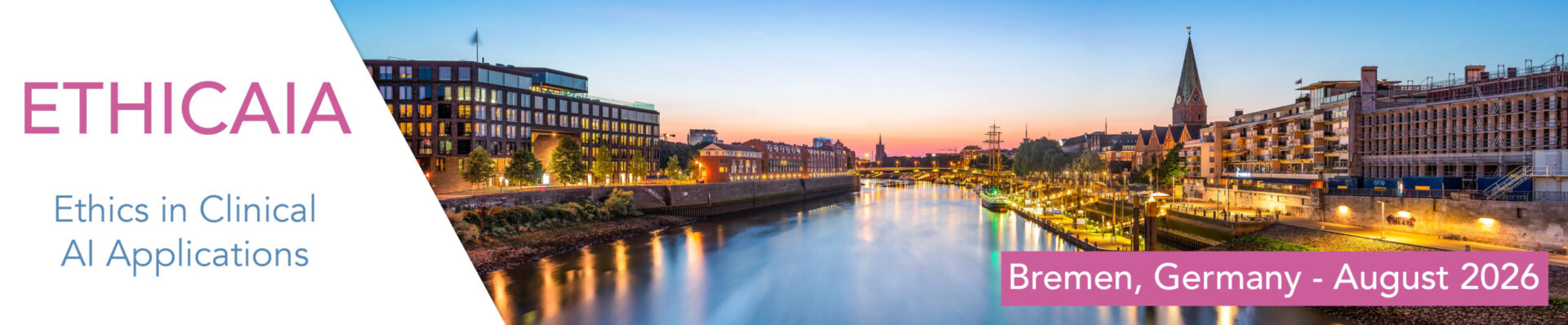
An IJCAI 2026 workshop.
ETHICAIA provides a focused venue for AI researchers to engage with ethical challenges in clinical applications of artificial intelligence. The workshop aims to strengthen the role of ethical considerations—such as fairness, robustness, accountability, and societal impact—within mainstream AI research on healthcare.
Held in conjunction with IJCAI/ECAI, ETHICAIA brings together researchers working across AI methodologies who are interested in responsible and trustworthy clinical AI. While grounded in technical research, the workshop is informed by perspectives from clinical practice and ethics through invited talks and discussion, encouraging participants to connect methodological advances with real-world implications.
The workshop welcomes contributions from across AI, including machine learning, natural language processing, computer vision, multimodal systems, and foundation models applied to healthcare.
Workshop Highlights
- Invited talks from experts in AI ethics and clinical AI
- Oral presentations of accepted papers
- Poster sessions to foster discussion and networking
- Panel discussion: “From Ethical Principles to Clinical Practice”
Scope and Contributions
ETHICAIA complements existing IJCAI tracks such as AI & Health, Human-Centered AI, and AI & Social Good. We particularly welcome work that:
Addresses ethical, fairness, or societal aspects beyond the scope of these tracks
Provides novel insights into responsible AI in clinical settings
Extends or revisits prior submissions with a stronger ethical perspective
By creating a dedicated space for these discussions, ETHICAIA aims to strengthen the role of ethical considerations within the broader AI research community.